
You see the result
before it’s permanent.
Ultra-thin shells fitted over the front of your teeth, correcting alignment, worn edges and uneven sizing — without the extensive preparation a full crown requires.
Thin shells, bonded to the front.
Veneers are ultra-thin porcelain or composite resin shells, custom-made to fit precisely over the front surfaces of your teeth. They change shape, shade, length and apparent alignment all at once.
Because they only cover the front, they need far less tooth removed than a crown, which wraps the whole tooth. That is the main reason to choose a veneer where one will do the job.
They work best where several front teeth need changing together. For one chipped tooth, bonding is usually the better answer.
What veneers correct
- Discolouration that whitening will not shift
- Chips and worn edges
- Teeth that are uneven in size or shape
- Small gaps between front teeth
- Mild crowding or apparent misalignment
Significant crowding is better treated by moving the teeth than by covering them.
Three visits, with a preview.
Consultation
Digital X-rays and intraoral camera imaging assess enamel thickness, the health of the tooth underneath and your gum levels.
We photograph your current smile for before-and-after planning, and select shade against a clinical guide.
Preparation
A minimal amount of enamel — typically 0.3 to 0.5mm — is removed from the front surface of each tooth, and impressions are taken.
Temporary veneers are fitted, protecting the prepared teeth and giving you a preview of the new smile.
Bonding
The permanent veneers are tried in, checked for fit and shade, and only then bonded in place.
If something is not right at the try-in stage, it is corrected before anything becomes permanent.
Some cases can be milled here and finished in a single appointment instead. Compare the two routes ›
0.3 to 0.5mm, and it does not grow back.
That is a small amount of enamel — far less than a crown requires — but it is permanent. Once it is removed, the tooth will always need something covering it.
This is the single thing we make sure people understand before they agree. Veneers are not a trial. If you have them and later decide against, the answer is new veneers, not bare teeth.
Which is what the temporaries are for. You wear the preview before the permanent work is made, so the shape and length are things you have lived with rather than approved from a photograph.
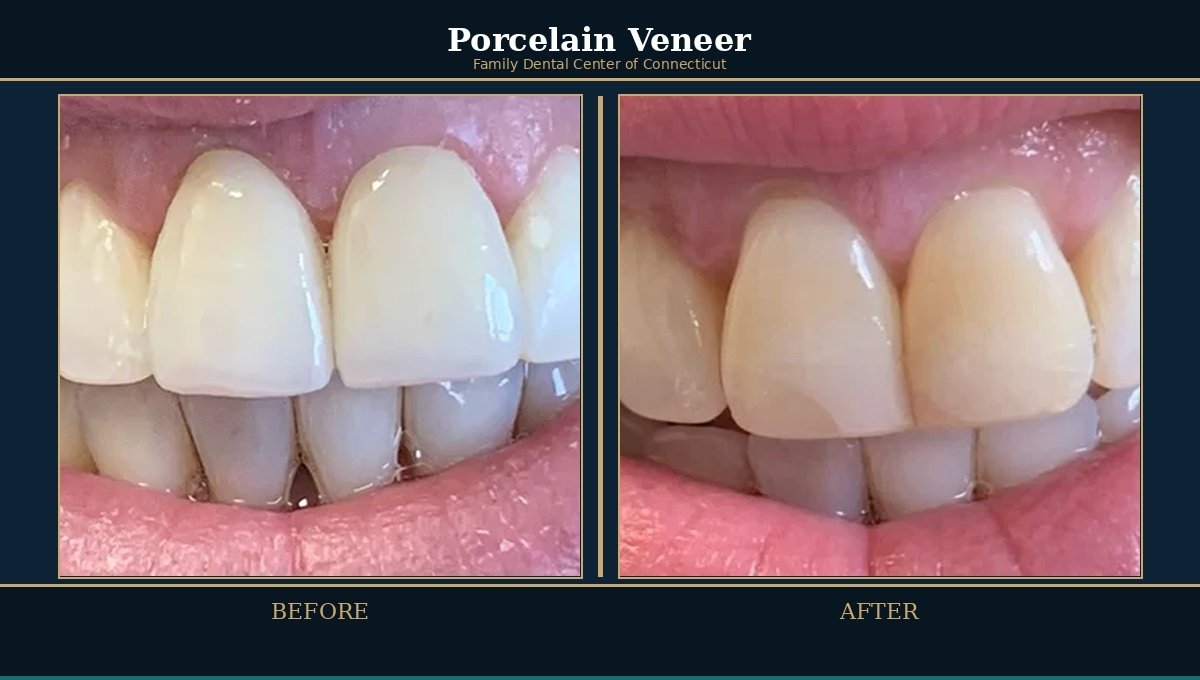
Porcelain is strong. It is not indestructible.
Veneers resist staining well and hold their appearance for years, but they can chip under the right kind of abuse — and grinding is the most common cause of failure.
If you grind your teeth, a custom night guard is not optional if you want the veneers to survive.
- Do not bite ice, pen caps or fingernails
- A custom night guard if you grind — this matters more than anything else
- Brush and floss as normal, including at the gum line
- Keep up regular professional cleanings
- Whitening will not change a veneer — whiten before, not after
Answered honestly.
How much tooth is removed?
Porcelain or composite?
Will they look fake?
How many teeth do I need done?
Can I whiten my teeth afterwards?
Does insurance cover veneers?
What if one chips?
Start with a conversation.
Tell us what bothers you about your smile. We’ll tell you honestly whether veneers are the right tool — or whether something simpler would do it.